Thursday, October 3, 2013

JFK Jr. Salutes his Father for the last time

Blog Post by Paul Farag


JFK Jr. Salutes his Father for the last time. Stan Stearns, November 25, 1963


Berenice Abbot and Walker Evans characterize selectivity as one of the most important aspects of photography, because it was gives it its weight as an art form, and as a form of social commentary. They argue that it is selection - the focus on subject matter which “hits hard” and “excites” the imagination - which turns photography into a “significant document” and a “penetrating statement.” I agree with their sentiment on the importance of selectivity, and I believe that it is in opposition to Daugerre’s thoughts on photography. By carefully selecting what we choose to record, what camera and lens to use, and what lighting to apply, we place ourselves in complete control of the creative process, empowering us to reproduce nature, whether its actual nature, or human nature.

The image I am choosing to discuss was taken by Stan Stearns, on November 25, 1963, at President John F. Kennedy’s funeral. The image is of President Kennedy’s son, John F. Kennedy Jr., saluting his Father’s casket one last time, as it is being taken to Arlington National Cemetery for burial. In the foreground, a Marine can be seen standing at attention, with a senior officer saluting the passing casket, perhaps inspiring the young boy to do the same. In the background, more officers can be seen. Most strikingly however, other than JFK Jr., is President Kennedy’s wife, Jacqueline, draped in all black, flanked by the rest the family, including Robert Kennedy. The arrangement of the people appears to be somewhat haphazard, lending to the somberness of the photo. Likewise, the choice to print it in black and white further adds to the tone. I chose this image because I feel as if I can understand the intentions of the photographer when he carefully selected to take this photo. Those intentions are to portray to the audience that this world changing event, one of the most important of the decade, can be reduced to one simple thing; that is, a family and, specifically, a son, saying good bye to their brother, husband, and father just one last time.

Smiles and Ghana Giggles {Documentary Photography}

Photographer: Mayumi Gellada Amargo


Wednesday, October 2, 2013

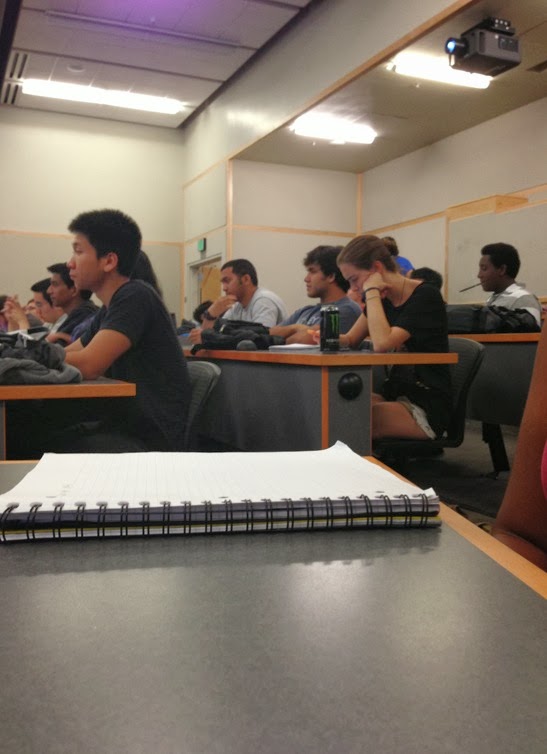
Documentary Photography - "Sit in the first three rows because there are fewer distractions."


McSorley’s Old Ale House (Straight Photography and Realism) Photo by: Bernice Abbott Blog Posted by: Kyle Chism


In the 1930s, Berenice Abbott was part of the straight photography movement, which stressed that scenes should be unmanipulated and depicted as realistically and objectively as possible. Abbott believed that a photograph could only “merit serious consideration, if it was directly connected to the world around us.” Her fascination with realism and capturing ordinary everyday life lead Abbott to the streets of New York City where she took hundreds of black and white photos depicting vendors, empty lots, skylines, subway stations and anything else she thought would “contain unparalleled beauties” while in their natural settings. According to Abbott many people are unaware of realism’s ability to exemplify the fantastic, unexpected, and ever changing qualities of the world. Using realism as her guide Abbott hoped to enlighten society of photography’s exceptional ability to record and document.
The photograph above, taken by Abbott in 1937 shows McSorley’s Old Ale House on East Seventh Street in New York. At a quick glance one just sees an old cluttered, dirty pub. However if one takes a closer look the photograph reveals exponential beauty within the many of stories it holds. None of the men are looking at the camera which one would assume means the picture was taken without warning. The significance of the scene taken with zero human, mechanical, or chemical influences, is that the stories told a “real”. The men in the bar appear fatigued and are probably relaxing at their favorite watering hole after a long days work. This is a much different story then would be recorded if Abbot had influenced the costume, positioning, or pose of the photographed individuals. Original signs on the walls advertise sandwiches for 10 and 15 cents giving a general sense of the economy at the time. The old rustic furnace reminds the viewer of the huge leaps in science and engineering that have been made in the last half a century. The bar’s dingy state shows the wear and tear of life at the time and the men’s suites reveal popular clothing styles. Like the subject matter, the physical photo is also unaltered, meaning there was no use of artificial lighting or image effects added before or after printing. The photo’s natural lighting and angle of focus are objective giving the viewer a universal point of view. The print is original and unaltered, its black and white gradient informs the viewer of the photograph’s true age. Like this photograph, much of straight photography is focused on documentation by conveying truthful information, evidence, and authentic judgment. The old time Pub has now become known as,” a bridge-and-tunnel attracting, frat-boy hangout.” New York Universities students may have temporarily changed this old pub’s atmosphere, but this photo will forever remain as documented evidence that in 1937 Mcsorley’s Old Ale House Pub provided a place to relax for the working class of New York City.

Pictorialism

 Autumn has arrived
neutral colors
redxblue
hates paparazzi

Pictorialism


Yosemite Mountains

Photographer: Schuyler Celso Herrera